

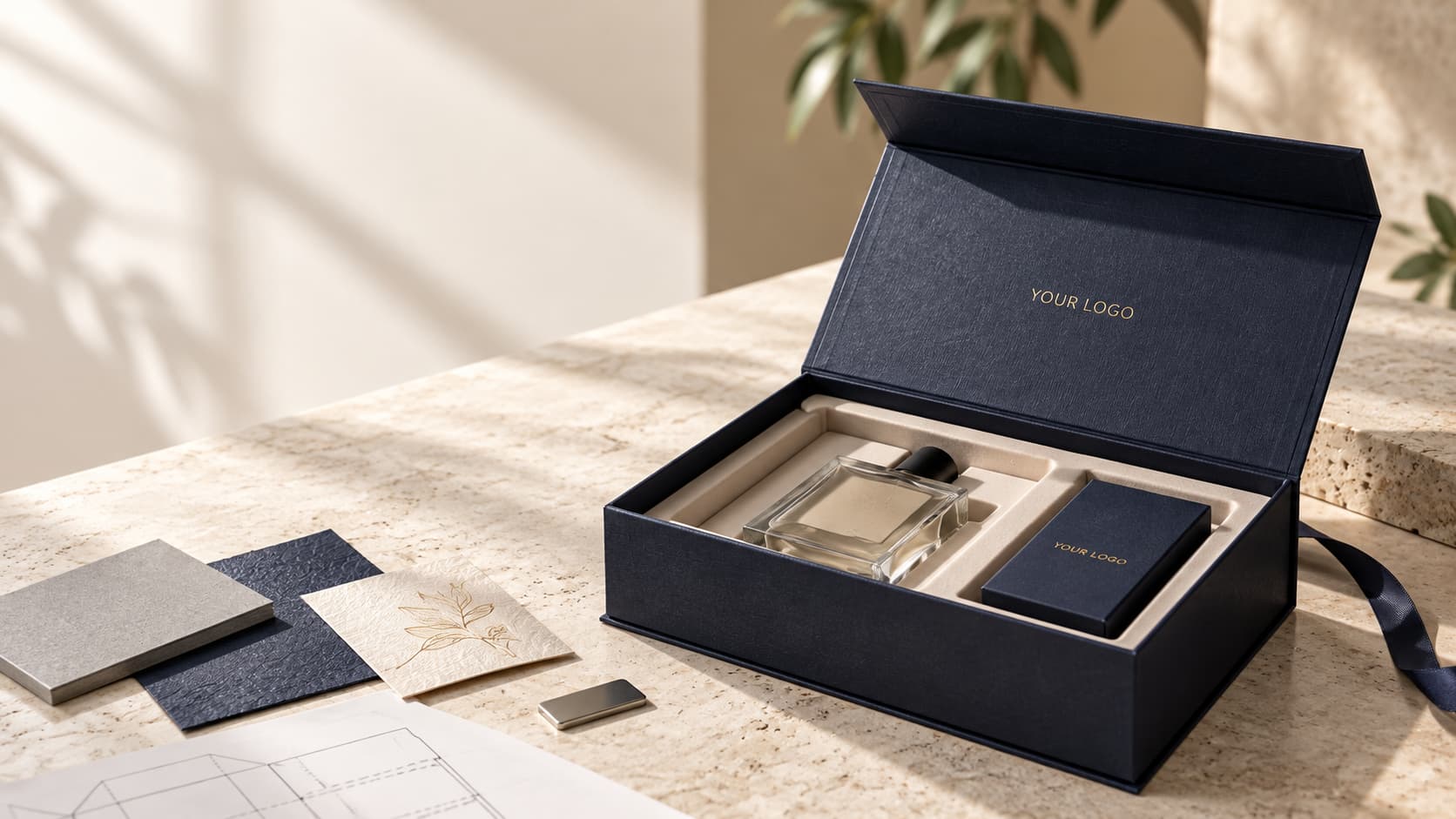
A rigid box can look simple from the outside: board, printed paper, a logo and perhaps a magnetic closure.
From a production and recycling perspective, however, the same box may contain greyboard, wrapping paper, adhesive, lamination, foil, magnets, ribbon, foam and other components.
That difference matters more for packaging intended for the European Union.
Regulation (EU) 2025/40 on packaging and packaging waste, commonly known as the PPWR, has applied since 12 August 2026. The Regulation establishes recyclability requirements, while more detailed design-for-recycling criteria and recyclability performance grades follow a staged implementation timetable.
Official source: Regulation (EU) 2025/40 — EUR-Lex
For packaging buyers, the practical question is therefore not:
“Are rigid boxes still allowed?”
A better question is:
“How should we design and specify a rigid box today so its materials, components and construction are easier to evaluate for the EU market?”
Before sending your next rigid box RFQ, these are seven areas worth checking.
1. Start With the Box Structure, Not the Surface Finish
Buyers often begin an inquiry with visual requirements:
- Matte black paper
- Gold foil logo
- Magnetic closure
- Ribbon
- Soft-touch finish
But the structural format should normally be decided first.
Three common options illustrate why.
| Structure | Main Advantage | What Buyers Should Consider |
|---|---|---|
| Book-style rigid box | Strong presentation and opening experience | Closure, hinge construction and additional components |
| Lid and base rigid box | Relatively straightforward construction | Fit, board thickness and insert design |
| Foldable rigid box | Reduced shipping and storage volume before assembly | Assembly method, corner construction and closure system |
A foldable rigid box, for example, may make sense when shipping volume is a major cost driver. A traditional book-style box may be preferable when presentation and structural rigidity are more important.
There is no universally “best” structure.
The correct structure depends on the product, distribution method, packing process, expected presentation and material strategy.
Buyer tip: Ask your packaging supplier to evaluate the structure before finalizing artwork. Changing a box structure after artwork approval usually creates unnecessary redesign work.
2. Ask for a Packaging Bill of Materials
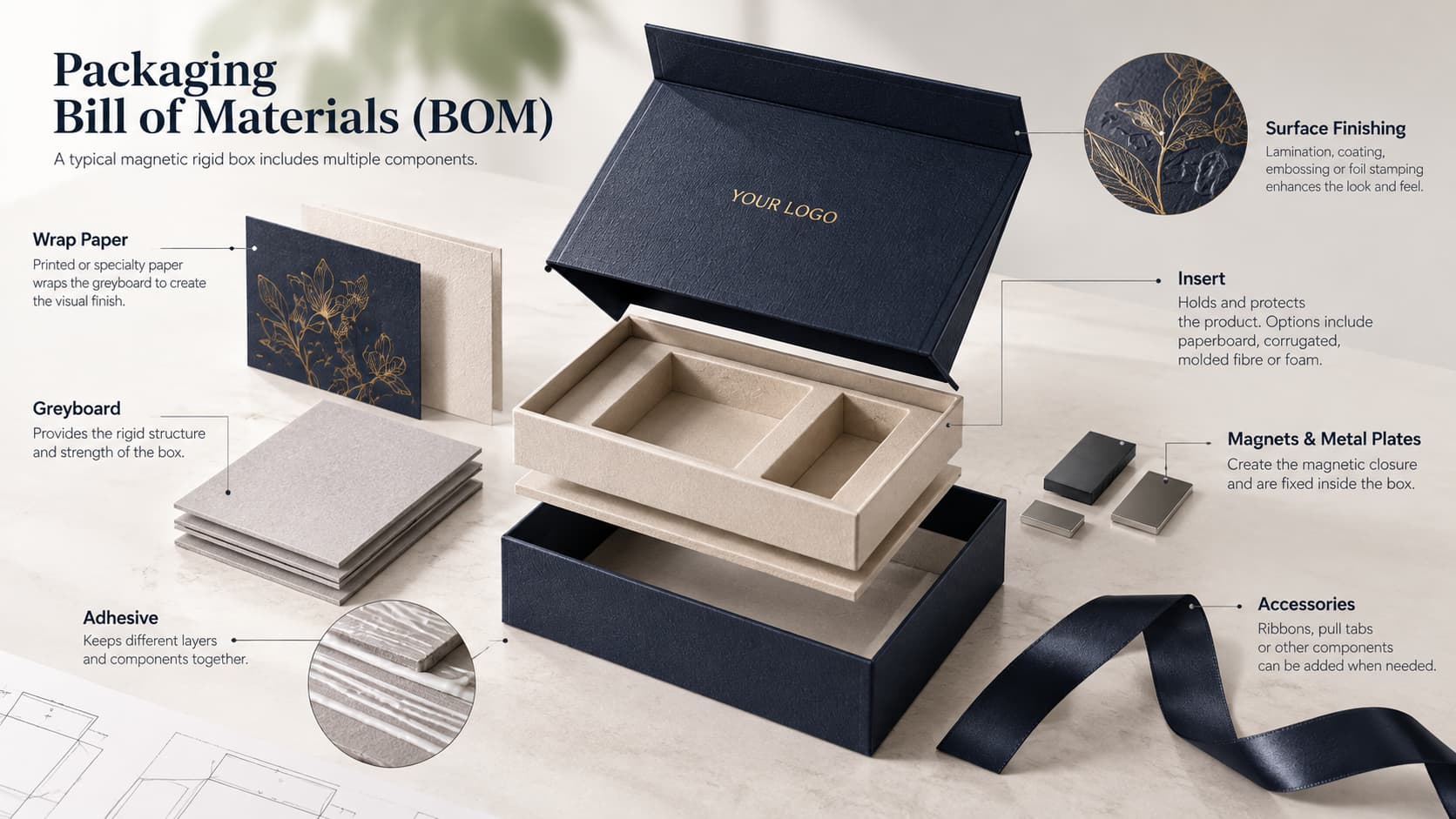
One of the most useful documents during packaging development is also one of the simplest: a basic Bill of Materials, or BOM.
Instead of describing a package only as a “paper rigid box,” break it into components.
A typical magnetic rigid gift box might include:
- Greyboard
- Printed or specialty wrapping paper
- Adhesive
- Surface coating or lamination
- Magnets
- Metal plates
- Paper, plastic or foam insert
- Ribbon
- Foil or other decorative elements
Why does this matter?
PPWR’s design-for-recycling framework does not look only at the material that visually dominates a package. Annex II identifies parameters including material composition, closures, adhesives, barriers and coatings, inks, and ease of dismantling when considering recycling design.
Official reference: Regulation (EU) 2025/40 — Annex II
A BOM gives the brand, packaging engineer and supplier a common starting point.
It also makes a useful question possible:
Which component is actually necessary, and which component is only there because the previous box used it?
That question can simplify packaging without automatically reducing perceived quality.
3. Treat Magnets and Closures as Components — Not as a Yes-or-No Question
We regularly see the same type of question around luxury packaging:
“Can I still use magnets for an EU rigid box?”
That question is too broad.
A magnetic closure is a separate component within the packaging system. Relevant considerations include:
- How many magnets are used
- Their size and weight
- How they are fixed into the box
- Whether additional metal components are required
- Whether components can be separated
- Whether the closure interferes with sorting or recycling processes
PPWR specifically recognises closures and other small packaging components as factors that can affect sortability, separability and recyclability.
That does not mean every magnetic rigid box is automatically non-compliant.
It means buyers should stop treating the magnet as an invisible part of the construction.
If a design can achieve the required opening experience with fewer components, a lighter closure or a simpler structural solution, it is worth evaluating before production.
The goal is not simply to remove everything that looks non-paper.
The goal is to understand what is being added and why.
4. Reconsider the Insert Before Defaulting to EVA Foam
For cosmetics, fragrance, electronics, jewellery and gift sets, the insert can be one of the most material-intensive parts of the entire package.
Common options include:
- EVA foam
- EPE foam
- Sponge
- Flocked or fabric-covered foam
- Folded paperboard
- Corrugated board
- Moulded fibre
Foam remains useful when cushioning, precision positioning or impact protection requires it.
But it should not automatically be the default.
For some products, a well-engineered paperboard insert can hold the product securely while simplifying the material system. Corrugated structures can also work well where protection is more important than a seamless presentation surface.
The decision should start with three questions:
How fragile is the product?
How precisely must it be positioned?
What happens to the packaging after the product is removed?
If a paper-based structure can achieve the required protection, it deserves consideration.
If foam is genuinely required, the supplier should document the material rather than disguising it under a general description such as “eco insert.”
Protection Comes First
Sustainability claims should never be achieved by creating packaging that fails during transport.
A damaged perfume bottle, cosmetic set or electronic product creates a much larger problem than a few grams of optimized packaging material.
Good packaging engineering is therefore a balance between:
Protection + material efficiency + production feasibility + end-of-life considerations.
5. Do Not Specify Lamination Automatically
“Matte lamination” appears on an enormous number of packaging RFQs.
Sometimes it is necessary.
Sometimes it is simply copied from the previous specification.
Before adding a film layer, determine what performance the finish needs to provide.
Is the objective:
- Abrasion resistance?
- Moisture resistance?
- A matte appearance?
- A soft tactile effect?
- Protection against fingerprints?
- Greater print durability?
Once the requirement is clear, different solutions can be compared.
Depending on the project, this could include:
- Film lamination
- Aqueous or other suitable coatings
- Varnish
- Uncoated specialty paper
- Paper with an inherent texture or tactile surface
Under the PPWR design-for-recycling framework, barriers and coatings are relevant because certain combinations may make recycling more difficult. Material combinations that support effective recovery of secondary raw material are preferable.
So instead of specifying a finish because it is familiar, specify the performance you actually need.
Your supplier can then discuss how to achieve it.
6. Premium Packaging Does Not Require More Materials
There is a common misconception in gift packaging:
More processes = more premium.
That frequently leads to constructions such as:
Greyboard + laminated printed paper + foil + Spot UV + metal badge + magnets + ribbon + EVA + fabric.
Each individual feature may look attractive.
Together, they can create a complicated package without necessarily creating a better design.
A more disciplined approach is to build visual value through fewer, better-controlled elements.
Specialty Paper + Embossing
A strong paper texture combined with blind embossing can create depth without relying on a large printed graphic.
Restrained Foil Stamping
A small foil logo often communicates more than covering a large percentage of the box in metallic decoration.
Structural Reveal
A drawer opening, book-style reveal or carefully proportioned lid can make the opening experience part of the design.
Colour and Paper Contrast
Changing the inner paper, insert colour or edge detail can create hierarchy without automatically adding another accessory.
The important principle is:
Premium packaging should come from design decisions, not from accumulating components.
This is useful commercially as well. Removing unnecessary processes can reduce production complexity while making the packaging specification easier to understand and control.
7. Send a Better RFQ Before Asking for the Price
A supplier cannot accurately evaluate a custom rigid box from a logo and quantity alone.
Before requesting a quotation, prepare as much of the following information as possible.
Rigid Box RFQ Checklist
1. Box Style
Book style, lid and base, drawer, foldable rigid box or another structure.
2. Finished Size
Length × width × height.
Whenever possible, provide the product dimensions as well.
3. Product Information
What will the box contain? Include approximate weight and fragility where relevant.
4. Order Quantity
Quotation tiers can also be requested if annual demand is uncertain.
5. Board and Paper Preference
If you do not know the exact specification, describe the desired strength, appearance and texture instead.
6. Printing
Artwork, colours and whether the design requires inside printing.
7. Finishing
Foil stamping, embossing, debossing, coating, lamination or other effects.
8. Insert
Paperboard, corrugated, moulded fibre, foam or supplier recommendation.
9. Closure and Accessories
Magnets, ribbon, pull tab, sleeve or other components.
10. Target Market
Tell the supplier if the packaging is intended for the EU or another regulated market.
11. Artwork Status
Final artwork, early concept or no dieline yet.
12. Shipping Destination
This matters when comparing structures with significantly different packing and shipping volumes.
A good RFQ allows the supplier to evaluate the complete packaging system rather than quoting an undefined box.
Do You Need to Remove Every Non-Paper Component?
No.
That is one of the most important points buyers should understand.
PPWR does not reduce packaging development to the rule:
“Paper = good, everything else = bad.”
Its recyclability framework is more technical.
Material composition, separability, coatings, adhesives, closures, printing and recycling processes all matter. PPWR also introduces recyclability performance grades, with the detailed design-for-recycling criteria following the Regulation’s implementation timetable.
This is why blanket claims such as:
“PPWR-certified rigid box”
or
“100% recyclable luxury packaging”
should be treated carefully unless they are supported by the relevant assessment and documentation.
As of October 2026, buyers should focus on understanding the construction, documenting materials and avoiding unnecessary complexity while monitoring the detailed criteria that will govern future recyclability assessments.
A Better Way to Develop an EU Rigid Box
A practical packaging development process can look like this:
Product → Structure → Material System → Insert → Closure → Printing & Finishing → Prototype → Review → Mass Production
Not:
Choose a beautiful reference box → add every requested finish → ask about recyclability at the end.
The earlier recyclability, material composition and separability are considered, the easier it is to make sensible changes.
For brands sourcing packaging from overseas, this also means involving the manufacturer before the design is completely locked.
A packaging factory can usually provide more value during structural development than after every dimension, material and finish has already been approved.
Frequently Asked Questions
Are magnetic rigid boxes banned under PPWR?
No general PPWR rule simply states that magnetic rigid boxes are banned. However, closures, small components, material composition and ease of dismantling are relevant to design-for-recycling considerations. The complete packaging construction should therefore be assessed rather than judging the box only by its main paper component.
Is EVA foam prohibited in EU packaging?
PPWR should not be interpreted as a simple list in which every common foam insert is automatically prohibited. Buyers should instead evaluate whether the material is necessary, how it affects the complete packaging system and whether an alternative such as paperboard or moulded fibre can provide the required protection.
Does foil stamping make a rigid box non-recyclable?
The presence of a decorative process alone is not enough to make a universal recyclability conclusion. The amount, material system and applicable design-for-recycling criteria all matter. Avoid unsupported claims and assess the complete construction.
Should I use only paper components for EU packaging?
Not necessarily. Packaging still needs to protect the product and perform its intended function. A better approach is to minimize unnecessary material combinations and use separable, well-documented components where possible.
What should I ask a packaging manufacturer before ordering?
At minimum, confirm the box structure, dimensions, board and wrapping paper, printing, coatings or lamination, decorative finishing, adhesive, insert, closures and other accessories. Requesting a clear packaging BOM can make later compliance and material review significantly easier.
Build the Specification Before You Build the Box
PPWR is changing the questions packaging buyers need to ask.
For rigid boxes, the discussion can no longer stop at:
“Can you make this design?”
The better conversation is:
“Can we achieve this appearance and protection with a structure and material system that is simpler, well documented and easier to evaluate for its intended market?”
That is not only a regulatory question.
It is good packaging engineering.
At Shanghai Puze Packaging Printing Co., Ltd., we work with custom rigid box structures, paper materials, printing, finishing, inserts and packaging accessories for B2B projects.
Have a rigid box project for the EU market? Get a Quote →
Regulatory note: This article provides general packaging design and sourcing information and is not legal advice. PPWR implementation includes delegated and implementing acts with staged deadlines. Requirements applicable to a specific package should be reviewed against the latest official EU rules and the product’s individual circumstances.